Showing posts with label extent. Show all posts

The Threat of Storms Wreaking Havoc in the Arctic Ocean

Arctic sea ice extent is close to a record low for the time of the year, as the image below shows.


Furthermore, the current decline in sea ice extent is much steeper than it used to be for this time of the year, raising the specter of sea ice hitting an absolute record low later this year. Moreover, a total collapse of sea ice may occur if storms continue to develop that push the remaining ice out of the Arctic Ocean into the Atlantic Ocean.


The threat posed by storms is illustrated by the track projected to be followed by Hurricane Arthur (above NOAA image, July 4), renamed as Post-Tropical Cyclone Arthur (NOAA image below, July 5).


The path followed by Arthur is influenced by the current shape of the jet stream. As the animation below illustrates, the jet stream looks set to prevent Hurrican Arthur from moving to the east and instead make it move into the Labrador Sea to the west of Greenland and - partly due to the high mountains on Greenland - continue to wreak havoc in Baffin Bay further north.

[ Note: this animation is a 1.87 MB file that may take some time to fully load ]
As described in an earlier post, post-tropical cyclone Leslie made landfall with hurricane-force winds in Newfoundland in September 2012. The large extratropical low pressure system continued to move rapidly northeastward across eastern Newfoundland at a forward speed of near 45 kt, and merged with a much larger extratropical low over the Labrador Sea.

Recent research by NOAA-affiliated scientists suggests that - over the years - the latitude where hurricanes, typhoons, and cyclones reach their maximum intensity on the Northern Hemisphere has shifted closer to the North Pole.

Such storms can bring lots of heat and moisture into the Arctic, and they can also increase the height of waves. All this can have devastating impact on the sea ice. The many ways in which storms can increase the dangerous situation in the Arctic is described in the post Feedbacks in the Arctic.

Last month, the June heat record broke in Greenland. Very high temperatures are currently recorded all over North America, as the image below shows.


Furthermore, sea surface temperature anomalies in the Arctic are currently very high, as the image below shows.


Additionally, the sea ice is currently very thin, as shown by the Naval Research Laboratory animation below.


The above animation further shows that there now is very little sea ice left in Baffin Bay, making it easier for storms to cause very high waves that could enter the Arctic Ocean and break the sea ice north of Greenland and Canada.

Arctic sea ice volume minimum is typically reached around halfway into September. This is still months away, but the prospect of an El Niño event striking this year now is 90%, according to predictions by the European Centre for Medium-range Weather Forecasts.

All this combines into a growing threat that hydrates contained in sediments will destabilize and that huge quantities of methane will be released abruptly from the seafloor of the Arctic Ocean. The risk that this will eventuate is intolerable and calls for parallel lines of action as pictured in the image below.

Climate Plan, July 7, 2014 version, as discussed at this Climate Plan post and at the Climate Plan blog

Related

- Storm enters Arctic region
arctic-news.blogspot.com/2012/09/storm-enters-arctic-region.html

- Huge cyclone batters Arctic sea ice
arctic-news.blogspot.com/2012/08/huge-cyclone-batters-arctic-sea-ice.html

- Hurricane Sandy moving inland
http://arctic-news.blogspot.com/2012/10/hurricane-sandy-moving-inland.html

- Feedbacks in the Arctic
http://arctic-news.blogspot.com/2014/03/feedbacks-in-the-artcic.html


Arctic sea ice in steep decline

Arctic sea ice area is in steep decline. The yellow line on the image below shows the sea ice area for 2014 up to June 1st, showing an almost vertical fall over the past few days.

[ click on image to enlarge ]
The Naval Research Laboratory image below compares the May 14, 2014, sea ice concentration (left) with the sea ice concentration forecast for June 10, 2014 (run on June 2, 2014, on the right).

[ click on image to enlarge ]
The NOAA image below shows sea surface temperature anomalies on June 3rd, 2014.


The NOAA image shows the huge sea surface temperature anomalies all over the Northern Hemisphere on June 3rd, 2014. Large areas with sea surface temperature anomalies up to 8 degrees Celsius and higher show up in and around the Arctic Ocean

[ click on image to enlarge ]
The image below shows sea surface temperature anomalies up to 1.5 degrees Celsius over the May-June 2014 period, with global average anomalies that hover just above 1 degree Celsius.


Above sea surface anomalies are very high, much higher than historic annual temperature anomalies over land and oceans, as shown on the image below for comparison.


In conclusion, the situation spells bad news for the sea ice, also given the prospect of an El Niño event projected to occur later this year. As discussed in earlier posts, the sea ice is already very thin, and as this image shows, ocean heat is melting the sea ice from beneath, while the sun is warming up the ice from above. At this time of year, insolation in the Arctic is at its highest, as Earth reaches its maximum axial tilt toward the sun of 23° 26'. In fact, insolation during the months June and July is higher in the Arctic than anywhere else on Earth, as discussed at this earlier post.

Feedbacks further accelerate warming in the Arctic, as described in the earlier post Feedbacks in the Arctic. Temperature rises of the water close to the seafloor of the Arctic Ocean is very dangerous, as heat penetrating sediments there could cause hydrate destabilization, resulting in huge amounts of methane entering the atmosphere over the Arctic Ocean.


Large Falls in Arctic Sea Ice Thickness over May 2014

Comparing ice thickness (in meters) on May 2, 2014 (left) and May 30, 2014 (right, forecast run May 25, 2014)
Arctic sea ice has shown large falls in thickness in many areas over the course of May 2014, as shown on above image. The animation below also compares the situation between May 2, 2014, and May 30, 2014 (as forecast by Naval Research Laboratory on May 23, 2014). Ice thickness is in meters.


Thickness is an important indicator of the vulnerability of the ice. If only looking at sea ice extent, one might (wrongly) conclude that sea ice retreat was only minor and that everything looked fine. By contrast, when looking at thickness, it becomes evident that large falls have occurred over the course of May 2014.

Falls at the edges of the sea ice can be expected at this time of the year, but the large fall closer to the center is frightening. On the one hand, it appears to reflect cyclonic weather and subsequent drift of the ice. On the other hand, it also indicates how vulnerable the sea ice has become. Last year, a large area showed up at the center of the sea ice where the ice became very thin, as discussed in July 2013 in the post Open Water at North Pole and again in the September 2013 post North Hole.

The appearance of huge weak areas at the center of the sea ice adds to its vulnerability and increases the prospect of total sea ice collapse, in case of one or more large cyclones hitting the Arctic Ocean later this year. To highlight the dangerous situation, the main image from a post earlier this month is again added below.


Adding to the concerns are huge sea surface temperature anomalies, as illustrated by the image below, showing anomalies at May 23, 2014, and created by Harold Hensel with ClimateReanalyzer and Google Earth.

[ click on image to enlarge ]
The image below shows sea surface anomalies on May 26, 2014, with an overlay of land temperatures, as created by Harold Hensel and edited by Sam Carana.


The image shows sea surface temperatures on the Northern Hemisphere that are 1.44 degrees Celsius warmer than the baselline temperature, despite large areas with cold water partly resulting from the huge amounts of meltwater flowing down along the edges of Greenland into the North Atlantic Ocean. The graph below shows Northern Hemisphere and Global sea surface temperature anomalies over May 2014.

By comparison, current (May 27, 2014) surface temperature anomalies of 0.64°C globally and 0.84°C for the NH. The image below shows annual temperature anomalies (land and ocean data).


Meanwhile, the development of this year's 'north hole' at the center of the sea ice appears to persist, as illustrated by the image below.


Outlook for sea ice remains bleak


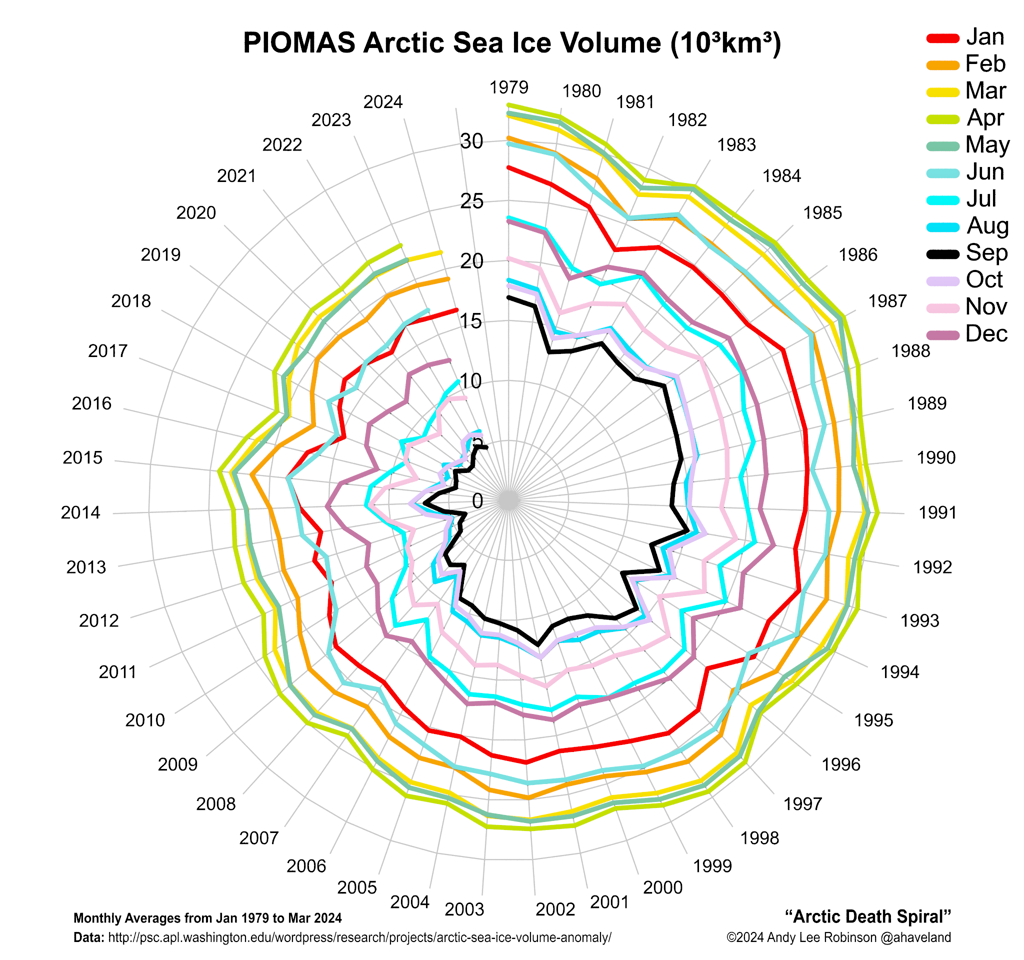
In April 2014, Arctic sea ice reached its annual maximum volume. It was the second lowest on record, according to calculations by the Pan-Arctic Ice Ocean Modeling and Assimilation System (PIOMAS) at the Polar Science Center. The ice volume in March 2014 also was the second lowest on record, as discussed in an earlier post. The fall in volume over the years is illustrated in the graph below, by Wipneus.
Another way of depicting the continuing fall in sea ice volume is the Arctic Death Spiral below, by Andy Lee Robinson.

The graph below, from the Danish Metereological Institute, shows mean temperatures that have been much higher than they used to be at higher latitudes. Mean 2 m temperatures for the region north of the 80th northern parallel as a function of the day of year are shown (red line), against the 1958 - 2002 mean (green line).


High levels of methane over the Arctic will have contributed to these high temperatures. Furthermore, the Jet Stream is changing as the difference in temperature between the Arctic and the equator decreases, causing more extreme weather events such as heatwaves and storms that could speed up the demise of snow and ice cover in the Arctic.

The graph below, by the Japan Aerospace Exploration Agency, shows that Arctic sea ice extent was 12,469,546 km² on May 8, 2014.

In addition, an El Niño event could cause even more ferocious heatwaves and storms to hit the Arctic. The image below, from IRI at Columbia University, shows that the chance of an El Niño event developing in the course of 2014 is close to 80%.


The outlook for the sea ice remains bleak and the possibility that a total collapse could occur in September calls for comprehensive and effective action, as discussed at the climate plan blog.


Has the descent begun?

On March 9, 2014, Arctic sea ice area was at a record low for the time of the year, at only 12.88731 square kilometers.


Sea ice extent shows a similar descent, as illustrated by the NSIDC image below.

NSIDC update: The image below shows that Arctic sea ice extent was 14.583 square kilometers on March 11, 2014 (light green line), a record low for this time of the year and smaller than it was in 2006 (magenta line) and 2011 (orange line) at this time of the year.


The situation is dire, given that methane concentrations have risen strongly following an earthquake that hit the Gakkel Ridge on March 6, 2014, as illustrated by the image below.

[ click on image to enlarge ]
Huge amounts of methane have been released from the seafloor of the Arctic Ocean over the past half year, and the resulting high methane concentrations over the Arctic will contribute to local temperature rises.

The image below shows that sea surface temperatures are anomalously high in the Arctic Ocean and off the east coast of North America, from where warm water is carried by the Gulf Stream into the Arctic Ocean.


The prospect of an El Niño event makes the situation even more dire. NOAA recently issued an El Niño Watch. This follows a conclusion by an international research team that found a 75% likelyhood of an El Niño event in late 2014.

The consequences of sea ice collapse would be devastating, as all the heat that previously went into transforming ice into water will be asbsorbed by even darker water, from where less sunlight will be reflected back into space. The danger is that further warming of the Arctic Ocean will trigger massive methane releases is unacceptable and calls for comprehensive and effective action as discussed at the Climate Plan blog.


Related

- M4.5 Earthquake hits Gakkel Ridge
http://arctic-news.blogspot.com/2014/03/m45-earthquake-hits-gakkel-ridge.html

- Climate Plan blog
http://climateplan.blogspot.com


M4.5 Earthquake hits Gakkel Ridge


The above image shows recent large methane release over the Gakkel Ridge, the faultline that crosses the Arctic Ocean between the northern tip of Greenland and the Laptev Sea (red line on map). Methane readings were as high as 2395 ppb at 586 mb, an altitude that often shows high methane readings originating from the Arctic Ocean.

An earthquake with a magnitude of 4.5 hit the Gakkel Ridge at a depth of 2 km on March 6, 2014, at 11:17.17.0 UTC. The location is shown on the map below.

[ click on image to enlarge ]
The image below shows more recent methane readings, around March 8, 2014.


The image below is a Naval Research Laboratory forecast of sea ice thickness for March 8, 2014, run on March 3, 2014.


Meanwhile, the sea ice is close to record lows (for the time of the year), as illustrated by the images below. The image directly below shows sea ice area.


The image below shows sea ice extent.


The image below, by Wipneus, shows sea ice volume.
The image below, by Andy Lee Robinson, offers a different way of looking at sea ice volume, the Arctic Death Spiral.


Arctic in early January 2014

In early January 2014, Arctic sea ice extent reached levels as low as they were in early January 2013, as illustrated by the image below.


Methane levels over the Arctic remain extremely high. The image below shows methane readings for the period January 1 - 11, 2014, with the inset showing the situation in 2013 for the same period.


Similarly, the image below makes a comparison between methane recorded in 2013 and in 2014 for this period (January 1-11), this time focusing on the Arctic and only showing methane readings of 1950 ppb and higher in yellow.


Below a combination of images by Dr. Leonid Yurganov, also comparing methane levels between early 2013 and 2014. The difference isn't as marked in the image below as in the above image, as the highest value in the image below is 1920+ ppb, whereas the above image highlights levels of 1950+ ppb.


These high methane releases from the seafloor of the Arctic Ocean are contributing to the over 20°C temperature anomalies that have hit parts of the Arctic Ocean recently, as illustrated by the image below.

In conclusion, the Arctic is hit by three kinds of warming, while there are at least 13 feedbacks that further accelerate warming in the Arctic, as described in the post The Biggest Story of 2013.


Is the North Pole now ice-free?

Is the North Pole now ice-free? It could well be that, by the time you read this, there will be no ice left at all at the North Pole. The image below, created by Sam Carana from a nowcast from the Naval Research Laboratory, run on September 17, 2013 and valid for September 18, 2013, shows open water extending all the way to a spot very close to the North Pole.


As the color indicates, sea ice thickness in this area is virtually zero (i.e. ice-free). This development of an ice-free area at the North Pole has been discussed in earlier posts such as:
  • Arctic sea ice thickness falls by 2m in 21 days in some areas (June 13, 2013)
  • Open Water In Areas Around North Pole (June 22, 2013), describing areas around the North Pole where sea ice thickness had fallen to virtually zero, i.e. open water. 
  • Open Water at North Pole (July 22, 2013), descibing a wide corridor that had developed with very thin ice between the North Pole and Siberia. The post added that surface water on top of this thin ice could extend along this corridor, all the way from the North Pole to edge of the ice, in which case the surface water effectively becomes part of open water.
  • North Hole (September 2, 2013), describing areas close to the North Pole where ice volume had fallen to virtually zero, while pointing at how devastating the impact of sea surface temperature anomalies can be. 
This sea ice thinning in areas close to the North Pole has been one of the most important developments in 2013. Yet, many people keep watching sea ice extent.

Why was Arctic sea ice not smaller in extent in 2013 than in 2012?

The comparison below shows both volume and the extent of the sea ice for the same day in 2013 (left), respectively 2012 (right). Natural variability can make Arctic sea ice slightly smaller or larger than projected. There are many factors that influence things from year to year, such as weather conditions, sea currents and temperatures of the water in the Atlantic and Pacific Oceans; some factors are discussed in more detail below.


The above comparison shows a lot more ice north of Alaska in 2013 (above left) than in 2012 (above right). The comparison below shows that salinity levels in the Beaufort Sea were lower in 2013 (below left) than in 2012 (below right).


Seawater typically has a salinity level of over 3%; it freezes at about −2°C (28°F). Where mixing occurs with fresh water runoff from melting glaciers and permafrost, the water in the Arctic Ocean can become substantially less saline. Other substances added to the water, such as sand, can also cause a freezing point drop. The freezing and melting point of fresh water (i.e. zero salinity) is 0°C (or 32°F).  Less salinity means the water will remain frozen until the temperature reaches levels closer to 0°C.

Thinning continues

Heatwave conditions in Alaska caused greater melting of the permafrost. The result was more fresh water run-off through the MacKenzie River into the Beaufort Sea. This has contributed to keep sea ice extent larger in 2013. Yet, the warm water has also contributed to further thinning of the ice, reinforcing warnings that the sea ice looks set to disappear altogether within years. 


As illustrated by the above image by Neven, from the Arctic Sea Ice blog, average Arctic sea ice thickness (crudely calculated by dividing PIOMAS (PI) volume numbers with Cryosphere Today (CT) sea ice area numbers) has been very low in 2013.

The image below shows that annual minimum volumes appear to follow an exponential trend downward to zero, firstly reached in September 2015, followed by zero ice in the surrounding months over subsequent years.

Some people have objected against using PIOMAS data for such projections, with arguments ranging from suggestions that PIOMAS data were not reliable, that natural variability could prove such projections to be wrong, to questioning whether an exponential trend was appropriate. Nonetheless, it seems that over the years arguments in favor of an exponential trend have only become stronger:
  • Further measurements such as by CryoSat have confirmed that the PIOMAS data are indeed reliable and that the sea ice decline may well be even more dramatic. 
  • Natural variability goes both ways, it can either speed up or slow down ice melt. Had there been less runoff from the MacKenzie River, the sea ice in 2013 may not have been able to refreeze after being hit by cyclones several times. Next year we may not be so lucky and sea ice could disappear altogether, due to natural variability.  
  • Thick ice along the northern coast of Greenland is indeeed more persistent because of on-shore winds that cause the ice to drift and pile-up there. This would favor a Gompertz (or Sigmoid) trend in extrapolations (see image on the right). However, the new development of an ice-free North Pole shows that the sea ice is capable of breaking up abruptly, not only from the outer edges toward Greenland, but also starting at the North Pole and even moving from there toward Greenland. Moreover, as the 30-day animation below shows, thick sea ice north of Greenland can thin very quickly, suggesting it could well disappear altogether within one season.  


Sea ice can thin rapidly, even when it is multiple meters thick 

Earlier in 2013, much warm water entered the Arctic Ocean from the mouths of rivers, as discussed in the post Arctic Ocean is turning red. As said, this resulted in lower salinity levels in the Beaufort Sea that prevented cyclones from demolishing the sea ice altogether. Nonetheless, the joint impact of cyclones and warm water does appear to have caused rapid decline of the thick ice north of Greenland and Canada, as earlier discussed in an earlier post

Furthermore, sea surface temperatures have been recorded close to Svalbard that are far higher than even in the waters closer to the Atlantic Ocean. This phenomenon is illustrated by the image below, showing sea surface temperatures (top) and sea surface temperature anomalies (underneath). 


In some of these spots, sea surface temperatures are well over 10°C (50°F). Where does this heat come from? 

These hot spots could be caused by undersea volcanic activity; this is the more dangerous as the area has seen methane bubbling up from hydrates that have become destabilized; such dangers have been discussed repeatedly, e.g. in the post Runaway Global Warming. Hot spots can also contribute to even more dramatic thinning of the sea ice, including the thickest parts. 

In conclusion, there is no reason to assume that the sea ice in the Arctic will somehow magically recover. Instead, there are many indications that exponential decline of Arctic sea ice will continue. Less salinity may have temporarily prolonged the extent of the sea ice in some areas, but as sea surface temperatures keep rising, the ever thinner ice looks set to collapse within years, with dire consequences. This calls for comprehensive and effective action, such as described at the ClimatePlan blog.  


Related posts

- Arctic sea ice thickness falls by 2m in 21 days in some areas
Arctic-news.blogspot.com/2013/06/arctic-sea-ice-thickness-falls-by-2m-in-21-days-in-some-areas.html

- Open Water In Areas Around North Pole
Arctic-news.blogspot.com/2013/06/open-water-in-areas-around-north-pole.html

- Open Water at North Pole
Arctic-news.blogspot.com/2013/07/open-water-at-north-pole.html

- North Hole
Arctic-news.blogspot.com/2013/09/north-hole.html

- CryoSat - New Dimensions on Ice
esa.int/Our_Activities/Observing_the_Earth/Living_Planet_Symposium_2013/New_dimensions_on_ice

- Arctic Ocean is turning red
Arctic-news.blogspot.com/2013/08/arctic-ocean-is-turning-red.html

- Cyclone raging on thin ice
Arctic-news.blogspot.com/2013/08/cyclone-raging-on-thin-ice.html

- Runaway Global Warming
Geo-engineering.blogspot.com/2011/04/runaway-global-warming.html

- Climate Plan
ClimatePlan.blogspot.com