Showing posts with label albedo. Show all posts

Where we are - A climate system summary

by Paul Beckwith


Air


The presence of GHGs (greenhouse gases) in the atmosphere is vital to sustain life on our planet. These GHGs trap heat and keep the global average surface temperature of the planet at about 15°C, versus a chilly -18°C, which would be our temperature without the GHGs.

We have changed the chemistry of the atmosphere, specifically of the concentrations of the GHGs. Concentrations of carbon dioxide have increased about 40% since the start of the industrial revolution (from a tight range between 180 to 280 ppm over at least the last million years) to 400 ppm. Concentrations of methane have increased by more than 2.5x since the start of the industrial revolution (from a tight range of 350 to 700 ppb) to over 1800 ppb. The additional heat trapped has warmed our planet by over 0.8°C over the last century, with most of that rise (0.6°C) occurring in the last 3 or 4 decades.

Oceans

Over 90% of the heat trapped on the surface of the planet is increasing the temperature of the ocean water. The increased levels of carbon dioxide in the atmosphere acidify the rainfall, and have increased the acidity of the oceans by about 40% in the last 3 to 4 decades (pH of the open ocean has dropped from 8.2 down to 8.05 on the logarithmic scale). An increased drop to a pH of 7.8 will prevent calcium based shells from forming, and threaten the entire food chain of the ocean. Changes in ocean currents, and vertical temperature profiles are leading to more stratification and less overturning which is required to transport nutrients to the surface for phytoplankton to thrive.

Global sea levels are presently rising at a rate of 3.4 mm per year, compared to a rate of about 2 mm per year a few decades ago. Melt rates on Greenland have doubled in the last 4 to 5 years, and melt rates on the Antarctica Peninsula have increased even faster. Based on the last several decades, melt rates have had a doubling period of around 7 years or so. If this trend continues, we can expect a sea level rise approaching 7 meters by 2070.

From: More than 2.5 m sea level rise by 2040
Land

Higher global average temperatures have increased the amount of water vapor in the atmosphere by about 4% over the last several decades, and around 6% since the start of the industrial revolution. Changes in heat distribution with latitude from uneven heating with latitude has slowed the jet streams and caused them to become wavier and fractured, and has changed the statistics of weather. We now have higher frequencies, intensities, and longer duration extreme weather events and also a change in location of where these events occur.

Feedback loops

The sensitivity of the climate system to increased levels of GHG appears to be much higher than previously expected due to many powerful reinforcing feedbacks.

From: Arctic Warming due to Snow and Ice Demise

Arctic temperature amplification from exponentially declining sea ice and spring snow cover are the strongest feedbacks in our climate system today. The average albedo (reflectivity) of the Arctic region has decreased from 52% to a present day value of 48% over 3 or 4 decades. The increased absorption of energy in the Arctic has increased the temperature at high latitudes at rates up to 6 to 8x the global average temperature change. The reduced temperature difference between the Arctic and equator has reduced the west to east speed of the jet streams causing them to slow and become wavier and more fractured, and directly causing a large change in the statistics of our global weather.

Methane gas emissions have been rapidly rising in the Arctic region from the terrestrial permafrost and the continental shelf marine sediments, most notably on the ESAS (Eastern Siberia Arctic Shelf). The extremely potent ability of methane to warm the planet (global warming potential GWP is >150, 86, and 34 times for methane relative to carbon dioxide on a few year, several decade, and century timescale, respectively) makes increased emissions an extremely dangerous risk to our well-being on the planet.

My overall assessment

Our climate system is presently undergoing preliminary stages of abrupt climate change. If allowed to continue, the planet climate system is quite capable of undergoing an average global temperature increase of 5°C to 6°C over a decade or two. Precedence for changes at such a large rate can be found at numerous times in the paleo-records. From my chair, I conclude that it is vital that we slash greenhouse gas emissions and undergo a crash program of climate engineering to cool the Arctic region and keep the methane in place in the permafrost and ocean sediments.


Paul Beckwith
Paul Beckwith is part-time professor with the laboratory for paleoclimatology and climatology, department of geography, University of Ottawa. Paul teaches climatology/meteorology and does PhD research on 'Abrupt climate change in the past and present'. Paul holds an M.Sc. in laser physics and a B.Eng. in engineering physics and reached the rank of chess master in a previous life. Click here to view Paul's earlier posts at the Arctic-news blog.


Related

- What's wrong with the weather?
http://arctic-news.blogspot.com/2014/07/whats-wrong-with-the-weather.html

- Arctic News: Polar jet stream appears hugely deformed
http://arctic-news.blogspot.com/2012/12/polar-jet-stream-appears-hugely-deformed.html


Heatwave to hit Greenland

A heatwave with temperature anomalies exceeding 36°F (20°C) is expected to hit Greenland between August 16 and 22, 2014, as illustrated by the image on the left and the animation on the right. 

Such heatwaves can be expected to hit the Arctic more frequently and with greater intensity, as temperatures in the Arctic are rising faster than elsewhere on Earth.

Such heatwaves can result in massive melting on Greenland, as persistent heat changes the texture of the snow and ice cover, in turn reducing its reflectivity. This makes that less sunlight is reflected back into space and is instead absorbed. 

The image below illustrates what a difference the presence of sea ice can make.
from: Arctic Warming due to Snow and Ice Demise
As the NSIDC/NOAA graphs below shows, melting on Greenland has been relatively modest this year when compared to the situation in 2012. By July 12, 2012, 97% of the ice sheet surface had thawed, according to this NASA analysis and this NOAA Arctic Report Card.


Melting on Greenland directly affects sea level rise, and melting on Greenland is accelerating due to a number of factors.

Projections of melting on Greenland have long been based on a warming atmosphere only, ignoring the warmer waters that lubricate glaciers and that warm Greenland's bedrock canyons that sit well below sea level.

Furthermore, there are growing quantities of black carbon deposits as a result of burning of fossil fuel and biomass. High temperatures have recently caused ferocious wildfires in Canada that have in turn caused a lot of black carbon to go up high into the atmosphere.

And of course, the atmosphere over the Arctic is warming up much faster than most models had projected. This in turn causes triggers further feebacks, including more extreme weather events such as heatwaves and rain storms that can be expected to hit Greenland with ever more frequency and ferocity. Further feedbacks include methane eruptions from the heights of Greenland, as discussed at the Arctic Feedbacks Page.

When also taking into account the accelerating impact of such factors on melting in Greenland, sea levels could rise much faster than anticipated, as illustrated by the image below.

from: more than 2.5m sea level rise by 2040? 

Note that sea level rise is only one of the many dangers of global warming, as discussed in the 2007 post Ten Dangers of Global Warming.

The image on the right shows a temperature forecast for August 16, 2014, with parts of Greenland changing in color from blue into green, i.e. above the melting point for snow and ice.

Such high temperatures are now hitting locations close to the North Pole ever more frequently, due to the many feedbacks that are accelerating warming in the Arctic, as discussed at this Feedbacks page.

One of the most dangerous feedbacks is a sudden eruption of huge quantities of methane from the seafloor of the Arctic Ocean, as discussed in a recent post.

The impact of such feedbacks can be accumulative and interactive, resulting in self-reinforcing feedbacks loops that can escalate into runaway warming.

Below is another forecast by ClimateReanalyzer for August 16, 2014, showing the remarkable ‘greening’ of Greenland, as well as the very high temperatures reaching the higher latitudes of North America.


Also see the very high sea surface temperatures around Greenland on the image below, created with ClimateReanalyzer.

Sea surface temperature anomalies on August 15, 2014. 
In conclusion, the situation is dire and calls for comprehensive and effective action, as discussed at the Climate Plan blog


Smoke Blankets North America


A thick layer of smoke blankets large parts of North America, as also illustrated by the animation below based on images from July 15 to 18, 2014, from Wunderground.com.

[ note that this animation is a 2.3MB file that may take some time to fully load ]
The are also extensive wildfires throughout the boreal forest and tundra zones of Central Siberia in Russia.

Such wildfires can send huge amounts of carbon dioxide, methane, soot, dust and volatile organic compounds into the atmosphere. Much of this gets deposited at higher latitudes, discoloring land, snow and ice, and thus speeding up warming by absorbing more sunlight that was previously reflected back into space.

Soils at higher latitudes can contain huge amounts of carbon in the form of peat, as described in the earlier post The Threat of Wildfires in the North. There are further conditions that make the situation in the Arctic so dangerous.
Temperature anomaly March-April-May-June 2014 (JMA)

The Arctic is particularly vulnerable to warming due to geographics. Seas in the Arctic Ocean are often shallow and covered by sea ice that is disappearing rapidly. Largely surrounded by land that is also rapidly losing its snow and ice cover, the Arctic Ocean acts like a trap capturing heat carried in by the Gulf Stream, which brings in ever warmer water. Of all the heat trapped on Earth by greenhouse gases, 90% goes into oceans, while a large part of the remaining 10% goes into melting the snow and ice cover in the Arctic, as described in an earlier post. Such basic conditions make that the Arctic is prone to warming.

Then, there are huge amounts of methane held in sediments under the Arctic Ocean, in the form of hydrates and free gas. Unlike methane releases from biological sources elsewhere on Earth, methane can be released from the seafloor of the Arctic Ocean in large quantities, in sudden eruptions that are concentrated in one area.

Until now, permafrost and the sea ice have acted as a seal, preventing heat from penetrating these methane hydrates and causing further destabilization. As long as there is ice, additional energy will go into melting the ice, and temperatures will not rise. The ice also acts as a glue, keeping the soil together and preventing hydrate destabilization from pressure changes and shockwaves resulting from seismic activity. Once the ice is gone, sediments become prone to destabilization and heat can more easily move down along fractures in the sediment, reaching hydrates that had until then remained stable.
 
Temperature anomaly March-April-May 2014 (NASA)
When methane escapes from the seafloor of the Arctic Ocean and travels through waters that are only shallow, there is little opportunity for this methane to be broken down in the water, so a lot of it will enter the atmosphere over the Arctic Ocean. The Coriolis effect will spread the methane sideways, but latitudes over the Arctic are relatively short, making the methane return at the same spot relatively quickly, while the polar jet stream acts as a barrier keeping much of the methane within the Arctic atmosphere. In case of large methane eruptions, the atmosphere over the Arctic will quickly become supersaturated with methane that has a huge initial local warming potential.

Hydroxyl levels in the atmosphere over the Arctic are very low, extending the lifetime of methane and other precursors of stratospheric ozone and water vapor, each of which have a strong short-term local warming potential. In June/July, insolation in the Arctic is higher than anywhere else on Earth, with the potential to quickly warm up shallow waters, making that heat can penetrate deep into sediments under the seafloor.

created by Sam Carana, part of AGU 2011 poster
The initial impact of this methane will be felt most severely in the Arctic itself, given the concentrated and abrupt nature of such releases, with the danger that even relatively small releases of methane from the seafloor of the Arctic can trigger further destabilization of hydrates and further methane releases, escalating into runaway warming.

This danger is depicted in the image on the right, showing how albedo changes and methane releases act as feedbacks that further accelerate warming in the Arctic, eventually spiraling into runaway global warming.

The currently very high sea surface temperature anomalies are illustrated by the two images below.


As the image below right shows, sea surface temperatures as high as 18 degrees Celsius (64.4 degrees Fahrenheit) are currently recorded in the Arctic.

Albedo changes and methane releases are only two out of numerous feedbacks that are accelerating warming in the Arctic.

Also included must be the fact that Earth is in a state of energy imbalance. Earth is receiving more heat from sunlight than it is emitting back into space. Over the past 50 years, the oceans have absorbed about 90% of the total heat added to the climate system, while the rest goes to melting sea and land ice, warming the land surface and warming and moistening the atmosphere.

In a 2005 paper, James Hansen et al. estimated that it would take 25 to 50 years for Earth’s surface temperature to reach 60% of its equilibrium response, in case there would be no further change of atmospheric composition. The authors added that the delay could be as short as ten years.

Earth's waters act as a buffer, delaying the rise in land surface temperatures that would otherwise occur, but this delay could be shortened. Much of that extra ocean heat may enter the atmosphere much sooner, e.g. as part of an El Niño event. Another buffer, Arctic sea ice, could collapse within years, as illustrated by the image below.

[ click on image to enlarge ]
The demise of sea ice comes with huge albedo changes, resulting in more heat getting absorbed by the Arctic Ocean, in turn speeding up warming of the often shallow waters of the Arctic Ocean. This threatens to make heat penetrate subsea sediments containing huge amounts of methane. Abrupt release of large amounts of methane would warm up the Arctic even more, triggering even further methane releases in a spiral of runaway warming.

Particularly worrying is the currently very warm water that is penetrating the Arctic Ocean from the Atlantic Ocean and also from the Pacific Ocean, as illustrated by the image further above and the image on the right.

The danger is that the Arctic will warm rapidly with decline of the snow and ice cover that until now has acted as a buffer absorbing heat, with more sunlight gets absorbed due to albedo changes and as with additional emissions, particularly methane, resulting from accelerating warming in the Arctic.

The numerous feedbacks that accelerate warming in the Arctic are pictured in the image below.

[ from: climateplan.blogspot.com/p/feedbacks.html ]
Furthermore, the necessary shift to clean energy will also remove the current masking effect of aerosols emitted when burning fuel. One study finds that a 35% – 80% cut in people's emission of aerosols and their precursors will result in about 1°C of additional global warming.

In the video below and the video further down below, Guy McPherson discusses Climate Change and Human Extinction.


This is further illustrated by the image below, showing how surface temperature rises are accelerating in the Arctic compared to global rises, with trendlines added including one for runaway global warming, from How many deaths could result from failure to act on climate change?
[ click on image to enlarge ]
The situation is dire and calls for comprehensive and effective action, as discussed at the Climate Plan blog.

Hat tip to Jim Kirkcaldy for pointing at the wildfire development at an early stage.

Near-Term Human Extinction

Global Warming and Feedbacks

Is there a mechanism that could make humanity go extinct in the not-too-distant future, i.e. within a handful of decades?

Most people will be aware that emissions due to human activity are causing global warming, as illustrated by the arrow marked 1 in the image on the left. Global warming can cause changes to the land, to vegetation and to the weather. This can result in wildfires that can in turn cause emissions, thus closing the loop and forming a self-reinforcing cycle that progressively makes things worse.

Furthermore, less forests and soil carbon also constitute a decrease in carbon sinks, resulting in carbon that would otherwise have been absorbed by such sinks to instead remain in the atmosphere, thus causing more global warming, as illustrated by the additional downward arrow in the image on the right. In conclusion, there are a number of processes at work that can all reinforce the impact of global warming.

Emissions can also contribute more directly to land degradation, to changes in vegetation and to more extreme weather, as indicated by the additional arrow pointing upward in the image on the right. A recent study by Yuan Wang et al. found that aerosols formed by human activities from fast-growing Asian economies can cause more extreme weather, making storms along the Pacific storm track deeper, stronger, and more intense, while increasing precipitation and poleward heat transport.

Accelerated Warming in the Arctic

Similar developments appear to be taking place over the North Atlantic. Huge pollution clouds from North America are moving over the North Atlantic as the Earth spins. In addition, the Gulf Stream carries ever warmer water into the Arctic Ocean. As the image below shows, sea surface temperature anomalies at the highest end of the scale (8 degrees Celsius) are visible off the coast of North America, streching out all the way into the Arctic Ocean.


As said, feedbacks as are making the situation progressively worse. Feedback loops are causing warming in the Arctic to accelerate. Warming in the Arctic is accelerating with the demise of the snow and ice cover in the Arctic, and this is only feedback #1 out out many feedbacks that are hitting the Arctic, as described in an earlier post. As the temperature difference between the equator and the Arctic decreases, the Jet Stream is changing, making it easier for cold air to move out of the Arctic and for warm air from lower latitudes to move in (feedback #10).


Abrupt Climate Change leading to Extinction at Massive Scale

The danger is that, as temperatures over the Arctic Ocean warm up further and as the Gulf Stream carries ever warmer water into the Arctic Ocean, large quantitities of methane will erupt abruptly from the seafloor of the Arctic Ocean, adding a third kind of warming, runaway warming resulting in abrupt climate change, and leading to mass death, destruction and extiction of species including humans.

Persistence of such a progression makes it inevitable that the rest of Earth will follow the huge temperature rises in the Arctic. Massive wildfires will first ignite across higher latitudes, adding further greenhouse gas emissions and causing large deposits of soot on the remaining snow and ice on Earth, with a huge veil of methane eventually spreading around the globe. The poster below, from an earlier post, illustrates the danger.

[ click on image to enlarge - note that this is a 1.8 MB file that may take some time to fully load ]
Views by Contributors

How likely is it that the above mechanism will cause human extinction within the next few decades? What views do the various contributors to the Arctic-news blog have on this?

Guy McPherson has long argued that, given the strengths of the combined feedbacks and given the lack of political will to take action, near-term human extinction is virtually inevitable.

In the video below, Paul Beckwith responds to the question: Can climate change cause human extinction?


Further contributors are invited to have their views added to this post as well. While many contributors may largely share Paul Beckwith's comments, it's important to highlight that contributors each have their own views, and this extends to their preference for a specific plan of action.

Geo-engineering

One of the more controversial issues is the use of geo-engineering. Guy McPherson doesn't believe geo-engineering will be successful. In the video below, Paul Beckwith gives his (more positive) views on this.


I must admit that the lack of political will to act is rather depressing, especially given the huge challenges ahead. So, I can understand that this can make some of us pessimistic at times. Nonetheless, I am an optimist at heart and I am convinced that we can get it right by giving more support to a Climate Plan that is both comprehensive and effective, as discussed at ClimatePlan.blogspot.com


March 2014 Arctic Sea Ice Volume 2nd lowest on Record

The March 2014 Arctic sea ice volume, as calculated by the Pan-Arctic Ice Ocean Modeling and Assimilation System (PIOMAS) at the Polar Science Center, was the 2nd lowest on record at 21.818 km³. Only March 2011 had a lower volume, at 21.421 km³, as illustrated by the graph below, by Wipneus.
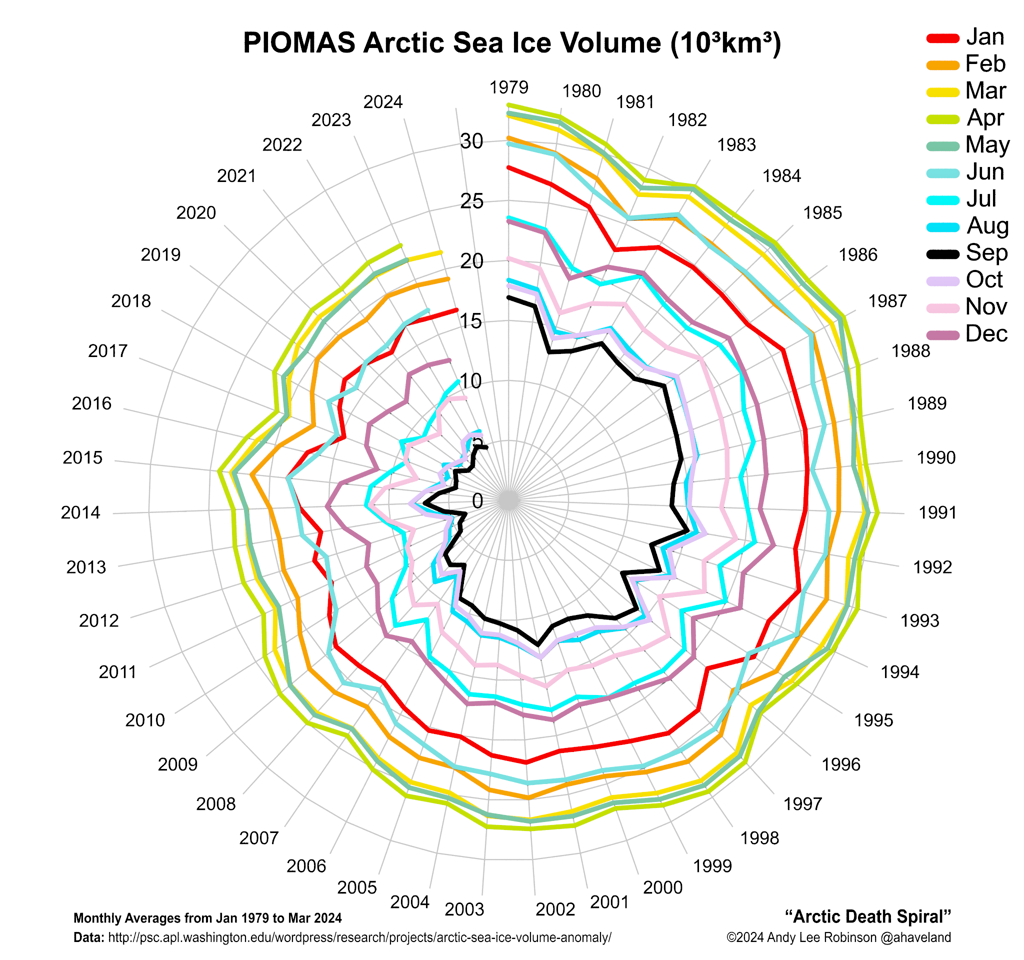
Another way of depicting the continued fall of the sea ice volume is the Arctic Death Spiral below, by Andy Lee Robinson.

This puts the sea ice in a very weak position. This month, the sea ice will reach its highest volume, which may well be the lowest volume on record for April. The Naval Reserach Laboratory 30-day animation below shows recent sea ice thickness.


The lowest sea ice volume for 2014 is expected to be reached in September, and - given the shape the ice is in now - will likely be one of the lowest minima on record. In fact, there is a chance that there will be no ice left whatsoever later this year. As illustrated by the image below, again by Wipneus, an exponential curve based on annual minima from 1979 points at zero ice volume end 2016, with the lower limit of the 95% confidence interval pointing at zero ice end of 2014.
Absence of sea ice will mean that a lot of more heat will be absorbed by the Arctic Ocean.

As NSIDC.org describes, sea ice reflects 50% to 70% of the incoming energy, but thick sea ice covered with snow reflects as much as 90% of the incoming solar radiation. After the snow begins to melt, and because shallow melt ponds have an albedo of approximately 0.2 to 0.4, the surface albedo drops to about 0.75. As melt ponds grow and deepen, the surface albedo can drop to 0.15. The ocean reflects only 6% of the incoming solar radiation and absorbs the rest. Furthermore, all the heat that during the melt went into transforming ice into water will - in the absence of ice - be absorbed by the ocean as well.


Such feedbacks are causing warming to accelerate in the Arctic Ocean, much of which is very shallow and thus vulnerable to warming. The Gulf Stream can be expected to keep carrying warmer water into the Arctic Ocean. Extreme weather events such as heatwaves and cyclones could make the situation a lot worse.

Warming of the Arctic Ocean threatens to destabilize huge amounts of methane held in sediments at the seafloor, in the form of free gas and hydrates. The danger is that release of methane from the seafloor of the Arctic Ocean will warm up the Arctic even further, triggering even more methane releases, as well as heatwaves, wildfires and further feedbacks, in a spiral of runaway warming that will lead to starvation, destruction and extintion at massive scale across the globe.

In conclusion, the situation is dire and calls for comprehensive and effective action, as discussed at the climate plan blog.


Colorado flooding, what does the IPCC say?

Flooding in Colorado has caused at least five death. As of 14 September, more than 500 were unaccounted for. Nearly 19,000 homes are damaged or destroyed.

Paul Beckwith comments:

Total destruction. Roads. Homes. Power lines. Water pipelines. Sewer culverts and pipes. And an oil pipeline. Not to mention the lives lost and disrupted forever.

Just be glad that the oil pipeline was not something like Keystone XL or Line 9 or Line 6.

Wake up people. Isn't it ironic that extreme weather events are accelerating in frequency, magnitude, spatial extent, and duration and are due to the very abrupt climate change that is being rapidly worsened from fossil fuel emissions; from burning the very stuff that is carried by the oil pipeline infrastructure.

And politicians are either very stupid or simply slaves to the fossil fuel companies since they ignore all laws protecting the environment, and even rewrite the legal system to eliminate any laws that slow or prevent pipelines, tar sands, fracking and any other fossil fuel infrastructure from being built. While publishing outright lies slamming renewable energy.

No wonder police forces across the world are becoming branches of the military; they realize that the public will soon be furious at the politicians and corporations and government corruption at all levels.

Meanwhile, according to the dailymail leaked IPCC reports say that "Global warming is just HALF what we said". So, what's going on? For starters, it appears that the IPCC has been fooled into ignoring the dangerous situation in the Arctic, i.e. albedo changes, methane and further feedbacks. The cartoon below illustrates this, please comment and share widely! 


Further feedbacks of sea ice decline in the Arctic

Arctic sea ice currently acts as a shield, preventing methane from entering the atmosphere, concludes a study by researchers from two Chinese scientific institutes

The researchers observed more methane in the water under the sea ice than the methane in the air above the sea ice. They conclude that the sea ice collects and holds the methane in places close enough to the surface for the methane to be consumed through photochemical and biochemical oxidation. In other words, sufficient light can reach the spots where methane assembles underneath the ice for the methane to get consumed by biological processes.

Change of CH4 mixing ratio over time in the chamber on under-ice water. In CBS1–CBS3, CH4mixing ratios fluctuated in the first 1–2 h and then increased, suggesting significant emission of CH4. No increasing trend in CBS4 might due to the relatively short sampling time (only 2 h) during which CH4mixing ratio had not started increasing.
A study by the Alfred Wegener Institute led by Marcel Nicolaus has found that where melt water collects on the ice, far more sunlight and therefore energy is able to penetrate the ice than is the case for white ice without ponds. The consequence is that the ice is absorbing more solar heat, is melting faster, and more light is available for the ecosystems in and below the ice.

As the sea ice has decreased in volume over the years, there now is mainly thin, first-year ice, extensively covered with melt ponds in the summer months, where once metre-thick, multi-year ice used to be. Additionally, the melt ponds have a different color, causing further albedo change. “Their colour depends entirely on how thick the remaining ice below the melt pond is and the extent to which the dark ocean beneath can be seen through this ice. Melt ponds on thicker ice tend to be turquoise and those on thin ice dark blue to black”, explains Dr. Marcel Nicolaus, sea ice physicist and melt pond expert at the Alfred Wegener Institute.

Graphic depiction of the amount of sunlight above and underneath the Arctic sea ice. The growing coverage of the ice by darker meltponds increases the share of sunlight, which passes the sea ice. That means, the space underneath the ice becomes brighter and warmer. Furthermore less sunlight is refleced back into the atmosphere. Graphic: Marcel Nicolaus/Yves Nowak, Alfred Wegener Institute
Marcel Nicolaus explains: “The young thin ice with the many melt ponds does not just permit three times as much light to pass through than older ice. It also absorbs 50 per cent more solar radiation. This conversely means that this thin ice covered by melt ponds reflects considerably fewer sun rays than the thick ice. Its reflection rate is just 37 per cent. The young ice also absorbs more solar energy, which causes more melt. The ice melts from inside out to a certain extent,” says Marcel Nicolaus.

Marcel Nicolaus adds: “The greater the share of one-year ice in the sea ice cover, the more melt ponds will form and the larger they will be. This will also lead to a decreasing surface albedo (reflectivity) and transmission into the ice and ocean will increase. The sea ice will become more porous, more sunlight will penetrate the ice floes, and more heat will be absorbed by the ice. This is a development which will further accelerate the melting of the entire sea ice area.”

These studies contain an important warning. As the sea ice gets thinner, more sunlight and therefore energy is penetrating the ice and getting absorbed. Initially, this will increase the growth of bacteria that break down methane collecting underneath the sea ice. Eventually however, as sea ice retreats further, there will be less opportunities for methane to be held underneath the sea ice and broken down by bacteria. Instead, more methane will then enter the atmosphere unaffected.

These are further feedbacks of sea ice retreat, in addition to the many feedbacks described in the Diagram of Doom. Sea ice is declining at exponential pace. The big danger is that a huge rise of temperatures in the Arctic will destabilize huge amounts of methane currently held in the seabed. Comprehensive and effective action is needed now to avoid catastrophe.

References

- Sea ice in the Arctic Ocean: Role of shielding and consumption of methane - Xin He et al.
http://dx.doi.org/10.1016/j.atmosenv.2012.10.029

Melt ponds cause the Artic sea ice to melt more rapidly - Alfred Wegener Institute news release

- Changes in Arctic sea ice result in increasing light transmittance and absorption - Marcel Nicolaus et al. DOI: 10.1029/2012GL053738

Dark Snow Project - Research into soot on Greenland

Fossil fuel combustion creates carbon emissions that increase atmospheric thickness, warming climate. The occurrence of wildfire increases with climate warming, increasing soot loading of the atmosphere. Some of this soot is transported through the atmosphere and is deposited on glaciers, lowering their reflectivity, increasing solar energy absorption, increasing melt rates.
image from DarkSnowProject.org

In parts of Greenland where winter snow loss during each melt season exposes impurity-rich bare ice, the surface reflectivity drops from 85% to 30%. Consequently, most of the 24-hour sunlight goes into ice melt. In this Dark Zone, the impact of soot manifests strongest in a self-reinforcing feedback loop that research by Jason Box has shown to have doubled melt rates in the past decade.

High on the inland ice sheet where melting is rare, satellite data show surface darkening making the researchers suspect that wildfire and industrial soot are to blame. Darkening here promotes snowpack heating, bringing earlier melt, keeping melt going longer. Here is where this feedback is changing the ice sheet in surprising ways, leading to complete surface melting in year 2012.


To measure the extent to which soot particles enhance melting, Jason Box is organizing a Greenland ice sheet expedition for 2013. The Dark Snow Project expedition is to be the first of its kind, made possible by crowd-source funding.


References

Fire and Ice: Wildfires Darkening Greenland Snowpack, Increasing Melting (News Release from Byrd Polar Center)
http://bprc.osu.edu/~jbox/DS/20121205_news_release_CALIPSO_etc.pdf

- The DarkSnowProject
http://darksnowproject.org

-Video: Sampling Greenland, the Dark Snow Project, by Peter Sinclair, produced at Greenman Studio, Midland, MI.
http://www.youtube.com/watch?v=vT6H7HPWkqU

- Where there’s fire there’s smoke - Blog by Jason Box, the Meltfactor.org


Further reading

- Greenland is melting at incredible rate
http://arctic-news.blogspot.com/2012/07/greenland-is-melting-at-incredible-rate.html

Albedo changes in the Arctic

How global warming and feedbacks are causing huge albedo changes in the Arctic.

Snow cover decline

Decline of the snow cover on land in the northern hemisphere is accelerating, as illustrated by the image below and the image underneath on the right. (1)


Image credit: Rutgers University
Fresh snow can have an albedo as high as 0.85, meaning that up to 85% of the sunlight falling on snow can get reflected back into space. As the snow melts, its structure changes making it less reflective, i.e. its albedo will go down, to as low as 40%. (2)

As a result, more sunlight gets absorbed, accelerating the melting process. Eventually, where snow melts away, spots of bare soil become exposed, and dark wet soil has a very low albedo, reflecting only between 5% and 15% of the sunlight. Thus, even more sunlight gets absorbed and the soil's temperature increases, causing more of the remaining snow to melt. (2)

Changes in vegetation can further accelerate this process. Russia's boreal forest - the largest continuous expanse of forest in the world - has seen a transformation in recent years from larch to conifer trees. Larch trees drop their needles in the fall, allowing the vast, snow-covered ground in winter to reflect sunlight and heat back into space and helping to keep temperatures in the region very cold. But conifers such as spruce and fir retain their needles, which absorb sunlight and increase the forest's ground-level heat retention. (3)

Albedo, from Wikipedia
A conversion from larch to evergreen stands in low-diversity regions of southern Siberia would generate a local positive radiative forcing of 5.1±2.6 W m−2. This radiative heating would reinforce the warming projected to occur in the area under climate change. (4)

Tundra in the Arctic used to be covered by a white blanket of snow most of the year. However, as the landscape is warming up, more trees and shrubs appear. Scientists who studied part of the Eurasian Arctic, found that willow and alder shrubs, once stunted by harsh weather, have been growing upward to the height of trees in recent decades. They now rise above the snowfall, presenting a dark, light-absorbing surface. This increased absorption of the Sun's radiation, combined with microclimates created by forested areas, adds to global warming, making an already-warming climate warm even more rapidly. (5 & 6)

Furthermore, encroachment of trees onto Arctic tundra caused by the warming may cause large release of carbon to the atmosphere, concludes a recent study. This is because tundra soil contains a lot of stored organic matter, due to slow decomposition, but the trees stimulate the decomposition of this material. (7)


Sea ice decline

In the Arctic, sea ice volume has fallen dramatically over the years, as illustrated by the image on the right. The trend points at 2014 as the year when Arctic sea ice will first reach zero volume for some time during that year. (8)

The Arctic Ocean looks set to be ice-free for a period of at least three months in 2015 (August, September and October), and for a period of at least 6 months from the year 2020 (June through to November). (9)

Decline of the Arctic sea ice is accelerating, due to numerous feedbacks. As the Arctic atmosphere warms up, any snow cover on top of the ice will melt away ever quickly, decreasing the surface albedo and thus reinforcing the warm-up. As melt ponds appear on top of the ice, the albedo will drop even further.

Sam Carana's Diagram of Doom pictures ten feedbacks that jointly work to accelerate sea ice decline. (10)

The image below shows the three areas where albedo change will be felt most in the Arctic, i.e. sea ice loss, decline of albedo in Greenland and more early and extensive retreat of snow and ice cover in other areas in the Arctic. (8)

Big changes in the Arctic within years, by Sam Carana


References

1. Northern Hemisphere Snow Cover Anomalies 1967-2012 June, Rutgers University
climate.rutgers.edu/snowcover/chart_anom.php?ui_set=1&ui_region=nhland&ui_month=6

2. Albedo, Albedo Change blog
albedochange.blogspot.com/2009/02/albedo-change.html

3. Shift in Northern Forests Could Increase Global Warming, Scientific American, March 28, 2011
scientificamerican.com/article.cfm?id=shift-northern-forests-increase-global-warming

4. Sensitivity of Siberian larch forests to climate change, Shuman et al., April 5, 2011, Wiley.com
onlinelibrary.wiley.com/doi/10.1111/j.1365-2486.2011.02417.x/abstract

5. Warming turns tundra to forest
ox.ac.uk/media/news_stories/2012/120604.html

6. Eurasian Arctic greening reveals teleconnections and the potential for structurally novel ecosystems, Macias-Fauria et al., 2012
nature.com/nclimate/journal/v2/n8/full/nclimate1558.html

7. Expansion of forests in the European Arctic could result in the release of carbon dioxide, University of Exeter news, June 18, 2012
exeter.ac.uk/news/featurednews/title_214902_en.html

8. Big changes in the Arctic within years, Sam Carana, October 26, 2012, Arctic-News blog
arctic-news.blogspot.com/2012/10/big-changes-in-arctic-within-years.html

9. Getting the Picture, Sam Carana, August 2012, Arctic-News blog
arctic-news.blogspot.com/2012/08/getting-the-picture.html

10. Diagram of Doom, Sam Carana, August 2012, Arctic-News blog
arctic-news.blogspot.com/2012/08/diagram-of-doom.html


Further reading

- Albedo change in the Arctic
arctic-news.blogspot.com/2012/07/albedo-change-in-arctic.html

- Greenland is melting at incredible rate
arctic-news.blogspot.com/2012/07/greenland-is-melting-at-incredible-rate.html

- Albedo change in the Arctic threatens to cause runaway global warming
arctic-news.blogspot.com/2012/10/albedo-change-in-the-arctic-threatens-to-cause-runaway-global-warming.html

Big changes in Arctic within years

Above interactive graphic illustrates the decline of the annual sea ice minimum volume in the Arctic over the years.

What trend can best be fitted to these data? Below, I've added a trendline that I believe best fits the data, but I encourage others to come up with better trends.


The trend points at 2014 as the year when Arctic sea ice will first reach zero volume for some time during that year. As discussed in the earlier post Getting the Picture, the Arctic Ocean looks set to be ice-free for a period of at least three months in 2015 (August, September and October), and for a period of at least 6 months from the year 2020 (June through to November).

Natural variability and strong feedbacks may speed things up further. Decline of sea ice in 2012 was such that we can expect a very low volume in December 2012, which could lead to inclusion of December in the period projected to be ice-free from 2020. That would make the ice-free period seven month long, i.e. well over half a year.

The image below shows the three areas where albedo change will be felt most in the Arctic, i.e. sea ice loss, decline of albedo in Greenland and more early and extensive retreat of snow and ice cover in other areas in the Arctic.


Related

- Getting the Picture
arctic-news.blogspot.com/2012/08/getting-the-picture.html

- Albedo change in the Arctic
arctic-news.blogspot.com/2012/07/albedo-change-in-arctic.html

- Greenland is melting at incredible rate
arctic-news.blogspot.com/2012/07/greenland-is-melting-at-incredible-rate.html

- Albedo change in the Arctic threatens to cause runaway global warming

Albedo change in the Arctic threatens to cause runaway global warming

Mark Flanner et al. calculated in 2011 that snow and ice on the Northern Hemisphere had a combined cooling effect of 3.3 Watts per square meter (of which 2 W/sm relates to the snow cover on land and 1.3 W/sm to the sea ice).

This cooling effect is deminishing rapidly, as temperatures rise and snow and ice cover declines. Snow and ice on the Northern Hemisphere had already declined substantially over the years and was reflecting 0.45 watts less energy per square meter in 2011 than it did in 1979 (Flanner, 2011).

As discussed in Albedo change in the Arctic, Professor Peter Wadhams calculates that the loss of the Arctic sea ice cooling effect alone can be compared to the net global warming caused by people's emissions (1.66 W/sm, IPCC, 2007b).
From: sites.google.com/site/arctischepinguin/home/piomas

The exponential trends added by Wipneus to PIOMAS Arctic sea ice volume data show that the Arctic Ocean looks set to be ice-free from 2015 onwards for the period from August through to October, while July and November look set to follow from 2017, respectively 2018 onwards with June following closely thereafter. In other words, we could soon face an Arctic Ocean that is ice-free for half the year.

Snow cover on land takes up an even larger area than sea ice. The chart below illustrates the decline of snow cover on land in the Northern Hemisphere (without Greenland) for the month June.


What trends could fit these data? On the image below, I've added trendlines and I encourage others to come up with better ones.

Clearly, a lot of snow and ice looks set to disappear over the next few years. Note that what happens in winter doesn't matter as much, as little sunlight reaches the Arctic in winter. What matters most is how much sunlight is reflected when insolation in the Arctic is high. Insolation during the months June and July is higher in the Arctic than anywhere else on Earth, as shown on the image below, by Pidwirny (2006).


While Greenland remains extensively covered with snow and ice, the reflectivity of its cover shows rapid decline, as illustrated by the image below. The July data since 2000, from the meltfactor blog with projection in red added by Sam Carana, suggest a exponential fall in reflectivity that looks set to go into freefall next year.
From: Greenland is melting at incredible rate

Albedo: wikipedia.org/wiki/Albedo

A drop of as little as 1% in Earth’s albedo corresponds with a warming roughly equal to the effect of doubling the amount of carbon dioxide in the atmosphere, which would cause Earth to retain an additional 3.4 watts of energy for every square meter of surface area (NASA, 2005; Flanner et al., 2011).

Combined, the snow line retreat, loss of sea ice and decline of Greenland's reflectivity constitute a huge loss of summer cooling in the Arctic.

As a result, summer temperatures in the Arctic look set to rise rapidly over the next few years, threatening to unleash massive amounts of methane from sediments below shallow waters of the Arctic Ocean, spiraling Earth into runaway global warming.

If you are also concerned about this development, please share the image below at Facebook, with a link to this post.


References
- Albedo - Wikipedia
wikipedia.org/wiki/Albedo

- Albedo change in the Arctic
arctic-news.blogspot.com/2012/07/albedo-change-in-arctic.html

- Flanner et al. (2011), Radiative forcing and albedo feedback from the Northern Hemisphere cryosphere between 1979 and 2008.
nature.com/ngeo/journal/v4/n3/full/ngeo1062.html

- Flanner et al. (2011), Presentation October 27, 2011, WCRP Open Science Conference
wcrp-climate.org/conference2011/orals/B11/Flanner_B11.pdf

- Greenland is melting at incredible rate
arctic-news.blogspot.com/2012/07/greenland-is-melting-at-incredible-rate.html

- NASA, 2005 (at Archive.org)
archive.org/details/albedo_ceres_mar05

Pidwirny, M. (2006). "Earth-Sun Relationships and Insolation". Fundamentals of Physical Geography, 2nd Edition
physicalgeography.net/fundamentals/6i.html

- PIOMAS monthly average sea ice volume, with exponential trends added
sites.google.com/site/arctischepinguin/home/piomas

- Snow Climate Lab, Rutgers University
climate.rutgers.edu/snowcover